Posts

International Education Day

Image
  International Education Day International Day of Education is an annual international observance day held on January 24 and is dedicated to education. On December 3, 2018, the United Nations General Assembly adopted a resolution proclaiming January 24 as the International Day of Education, in celebration of the role of education in bringing global peace and sustainable development.  Without inclusive and equitable quality education and lifelong opportunities for all, countries will not succeed in achieving gender equality and breaking the cycle of poverty that is leaving millions of children, youth and adults behind. Today, 258 million children and youth still do not attend school; 617 million children and adolescents cannot read and do basic math; less than 40% of girls in sub-Saharan Africa complete lower secondary school and some four million children and youth refugees are out of school. Their right to education is being violated and it is unacceptable. Students of Nai D...

Cover Story - National Education Policy(NEP) 2020

Image
The implementation of previous policies on education had focused largely on issues of access and equity. The unfinished agenda of the National Policy on Education 1986 , modified in 1992 (NPE 1986/92), is appropriately dealt with in NEP 2020. A major development since the last Policy of 1986/92 has been the Right of Children to Free and Compulsory Education Act 2009 which laid down legal underpinnings for achieving universal elementary education.  For our first cover story, we will be delving into the key agendas from NEP 2020 . For the convenience of our readers, we have included a brief summary as well. This issue of our NewsDesk is quite info-heavy, so grab some snacks and enjoy reading! Index- A new education structure Formation of a new curriculum New Integrated learning  Flexibility in secondary education A complete correction of the assessment and grading system Changes in the Board and Entrance Examinations Reforms at the College/University stage A brief summary ...

An Open Letter to all Journalists

  An Open Letter to all Journalists Dear Journalists, Thank you.  Journalism nowadays can be one of the most exhausting and demanding tasks in media. Despite this, you continue to provide us with unbiased and fact-based content. For this, we are extremely grateful. Though it can be quite easy to use raunchy headlines or irrelevant content to bump numbers up, you still choose to be truthful and maintain integrity.  The current youth needs to be educated to create an intelligent future. Educated not just in academics, but also in the field of current affairs. To truly understand the problem of others, we need to be empathetic. Empathy develops in people through communication and listening to their stories. Journalism, in essence, is the art of storytelling from different perspectives.  Building trust and connection between the readers and the writers, be it parasocial  in nature, can help a lot in content absorption. Accepting feedback from the community is also j...

Why do we fall for fake news?

Image
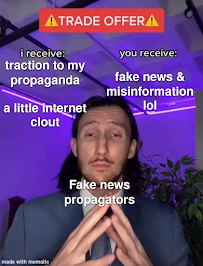
Why do we fall for fake news?   DANGERS OF SPREADING FAKE NEWS Fake News is a false narrative published & promoted as if it were true. As is evident through the past, propaganda is spread through this. It is usually spread by those in power to create a certain belief or support a certain position even it was completely false. This really has serious consequences on the entire world. Social media has now created an environment where anyone with an agenda can publish falsehoods as if they were truths. People can be paid to post fake news on behalf of someone else or automated programs, often called bots, can publish auto-generated fake news. Take this meme as an example:  It is usually created to change people’s beliefs, attitudes, or perceptions, the ultimate goal is to change their behaviour. If you fall for fake news, then someone else drives your beliefs and decisions. Stories that are untrue and that intentionally mislead readers have caused growing mistrust among...

Our Story

Image
 Our Mission Statement To present teenage-friendly news for our community members to make them aware of current affairs and inspire them to be responsible citizens, being the change themselves. Our What, How and Why Here at The Veritas News Desk, we aim to provide our audience with the news they like. Be it sports, current affairs, the introduction of new policies or anything informative that one needs to be acquainted with, we strive to present it in a friendly manner. We publish completely uncensored & unbiased news and refrain from sharing any propaganda. Even though the news we present is uncensored, we try our best to present it in a comical and interesting manner that's engaging. We plan to present local news, especially news that concerns students. We aim to publish at least one issue every fortnight. That said, is news these days  really  true or easily understandable? Sadly, no. A lot of news sources use complicated words and advertise other news and sources,...

Debunking Propaganda

Image
An Anti-Propaganda Resource “ Social media allows you to reach virtually anyone and to play with their minds.” -Uzi Shaya, former senior Israeli intelligence officer Before we debunk propaganda, we need to know what propaganda is . Propaganda is information of a biased or misleading nature that is used to influence public opinion for ideological, political or commercial purposes. It achieves this by targeting and appealing to the emotions and beliefs of the public.  Propaganda is often one-sided and manipulative and thus spreads because of the absence of context.  Propaganda is extremely dangerous. In this resource, we state 5 reasons why you must not share propaganda.     1. Propaganda affects our mental health :  Consuming or interacting with too much propaganda affects our mental health severely. For example, misinformation on Covid-19 had many adverse effects on the mental health of the public. 2. Propaganda affects the way we approach situations and ma...